Dr. Mary Ehrenworth, CCIRA Conference Featured Speaker
Picture this: you’re reading aloud a gorgeous, significant picture book – perhaps it’s My Papi Has a Motorcycle, written by Isabel Quintero and illustrated by Zeke Peña. You invite students to share their thoughts about the narrator, and they say she’s curious, and happy (she is). But they don’t say she is inquisitive, and joyful, at times even euphoric.
Or perhaps you teach high school, and your students are thinking about Holden Caufield. They say he is depressed. But they don’t have the language to consider if he is depressed as in nostalgic, or depressed as in friendless, or depressed as in forsaken or depressed as in desolate, or perhaps he is a bit of all of those.
When kids develop more expressive language to describe characters, they also are better able to develop nuanced interpretations. They learn to think about depths of emotional intensity, and how powerful a trait is, and how characters are multifaceted.
Acquiring Words to Describe Characters – and Starting with Digital Narratives
One of the most useful ways to actively support students’ literary vocabulary acquisition is to build literary vocabulary collections. To do this work, you won’t focus on the words that are in the stories students read, but instead you focus on words readers use to talk about these stories, especially words to describe characters (Ehrenworth, 2025; Hiebert, 2011, 2020). A lot of the particularly hard words that appear in stories tend to be Tier 3, or rare, specialized words (Beck et al., 2013), that won’t appear in the next story students read. But when we collect words to describe characters, we can focus on collecting Tier 2, precise words, which will be useful for describing many characters, in many situations. And as we work on collecting more precise words, we are also building more nuanced interpretations.
Now picture that you are ‘reading’ Joy and Heron with your students. It’s a Pixar animated short narrative about a puppy, Joy, who goes fishing with her owner and encounters a bird, Heron, who keeps stealing the worms the fisherman needs to fish. To do this work, you’ll:
- Set students up in partnerships, each partnership with a notebook or paper to share, sticky notes (so later, kids can sort these words), and something to write with (sharpies are best for this).
- Introduce the work – that you will all be collecting words to describe Joy and Heron, and that in order to do that, readers will have to pay attention to small details, as the author is never going to say, “And so this shows that deep down, Joy was…lonely.”
- Model – your own collection will act as an implicit model, and it becomes the shared, class collection – it could be chart paper, or if you have a document camera, it might be your notebook, or a piece of paper – but use sticky notes, so you’ll be able to sort these words later.
- Launch kids into collecting, sharing, and defending words to describe characters by watching just a snippet of the video (reading the beginning of the story) and jotting and talking to their partner about the words they have to describe Joy just in her path from the dock to the boat, such as energetic, excited, nervous.
- Coach kids to support their ideas with details from the text – teach partners to ask, “What makes you say that?”
- Teach kids some more sophisticated words, building on words they have, and giving examples from the story. For example, another word for excited can be buoyant, especially when someone is so bouncy, like Joy when she twirls in the air. And another word for nervous can be cautious, especially when Joy does get on the boat, but she puts her paw on the boat with caution.
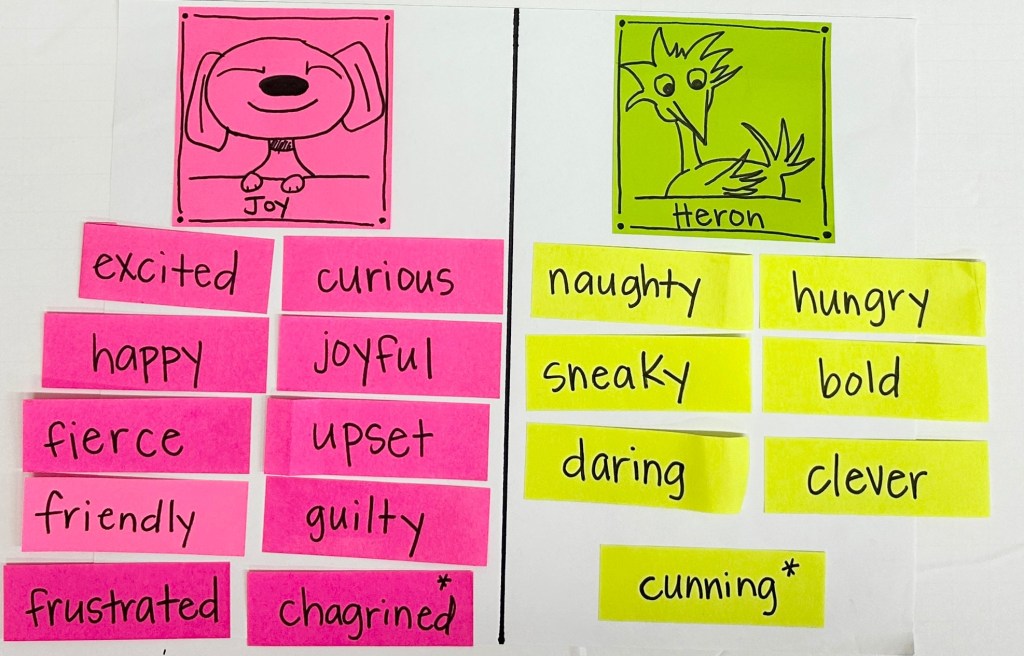
What’s beautiful about this work is that soon, kids have many words in their own collections – some of them familiar, some of them new – and these words are attached to characters they care about. The word collection acts as a semantic cluster, and kids will have a lot of opportunity to hear these words, see them, and talk about them.
I describe this work in Vocabulary Connections: A Structured Approach to Deepening Students’ Academic and Expressive Language (2025). In the research for that book, and in the many classrooms I’ve worked in since publication, the single word I would use to describe this work is: joyful. Another word would be lasting. And a third word would be significant. Not every child gathers all the same words. Not every child spells every word correctly. But they gather a collection of literary vocabulary that lets them talk about characters with more nuance, and now you can build on this work, so that it both sticks and grows.
Deepening Usage, Transfer, and Agency
Once students have been introduced to this work, there are a variety of ways to deepen and extend it, so that kids get to use these words more, add to their collections, and overall, expand their expressive language. Here are a few ways to go on with this work:
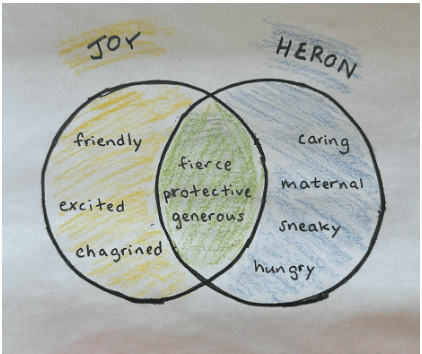
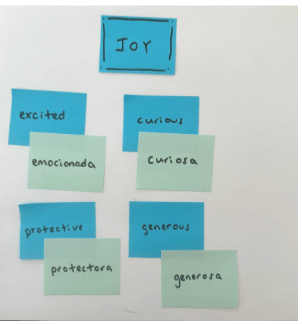
- Create conceptual sorts. You might invite readers to sort some of their words by Emotions vs. Traits, or by Strengths vs. Flaws, or by Inside vs. Outside, or to create venn diagrams or other categories that students come up with. What matters here is that by asking readers to sort, you are forcing higher level thinking. As your readers, for example, decide that furious is more of an emotion for Joy, while protective is more of a trait, or as they wonder about empathetic, they are practicing nuanced literary interpretation work.
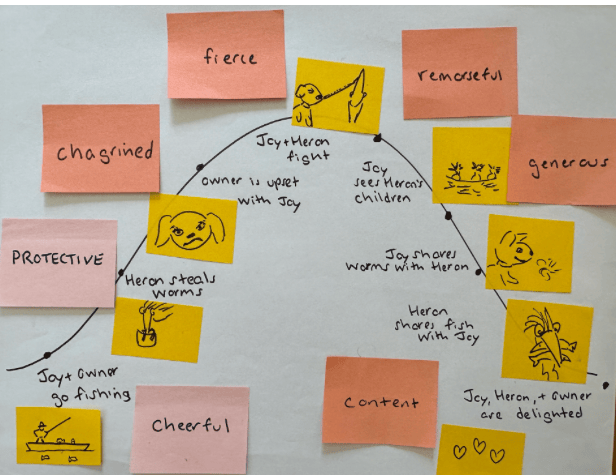
- Work with story mountains. If you invite your readers to create a story mountain for Joy and Heron, they can then make decisions about which of their words best matches each moment on that storyline, which means they need to think about part-to-whole work, as well as change over time. These two skills, by the way, are much assessed on state ELA exams, and give young readers a lot of trouble. Many readers tend to hold onto an idea they came up with about a character early on in a narrative, and they struggle to let go of it even in the face of new evidence.
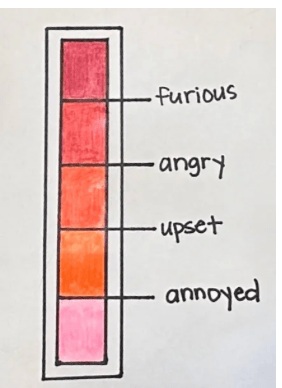
- Introduce verticals. Verticals, or words that are grouped around a shared meaning and ordered in intensity in a ladder, are incredibly useful. You anchor the vertical with a Tier 1, easy word, like mad. Then you go from a little mad, such as annoyed, to really mad, such as furious or enraged. When you put verticals into play, kids will use them all the time, not just in read aloud, but for book clubs as well.
- Invite students to translanguage and translate. We know that it’s important for students to develop literary vocabulary in all their languages, and that growth in their home language will support growth in English. All of this work will be inclusive for multilingual learners, especially when you begin with wordless, digital narratives. (Ehrenworth et al., 2025; Espinosa and Ascenzi-Moreno, 2021; Garcia et al., 2017).
- Create opportunities for transfer. Invite students to continue this work with other texts you read aloud, and with the books they read for book clubs or independent reading or for shared class texts.
All of this work is easy to introduce, joyful in its implementation, and has enormous possibilities for transfer. It also helps us increase equity in our work with language acquisition. When I was a young teacher, I think I hoped that readers would acquire vocabulary simply by reading a lot. That kind of incidental learning does occur – but it happens more for kids who already read at high levels, who have lots of access to print, and who read prodigiously. Sonia Cabell (2020) reminds us that we need to ensure that all kids, even kids who find print hard, get access to this same kind of complex thinking, with complex texts, and, I would add, with opportunities to build complex vocabulary.
Resources
All of this work is documented in Vocabulary Connections: A Structured Approach to Deepening Students’ Academic and Expressive Language by Mary Ehrenworth (Stenhouse, 2025).
Please visit www.vocabularyconnections.org, to access additional resources.
All images included in this text are from Vocabulary Connections by Mary Ehrenworth. Taylor & Francis Group. © 2025. Thank you to Jennifer Zanghi for her beautiful word charts and illustrations.
References
Beck, I. L., McKeown, M. G., Kucan, L., McKeown, M. G., & Kucan, L. (2013). Bringing words to life: Robust vocabulary instruction (2nd ed). The Guilford Press.
Cabell, S. (2020). Choosing and Using Complex Text: Every Student, Every Day. Massachusetts Department of Elementary and Secondary Education. https://www.doe.mass.edu/massliteracy/literacy-block/complex-text/choosing-using.html
Ehrenworth, Mary, Gould, Lauren, & Roman, Alexandra. (2025). Joyful Vocabulary Acquisition: Pedagogies for Developing Children’s Literary Vocabulary (and Analysis of Characters in Narratives). In Multiliteracies, Multimodality and Learning by (Inclusive) Design in Second Language Teacher Education (Agustín Reyes-Torres, María Estela Brisk, and Manel Lacorte). Routledge, Taylor & Francis Group.
Espinosa, C. M., & Ascenzi-Moreno, L. (with García, O.). (2021). Rooted in strength: Using translanguaging to grow multilingual readers and writers. Scholastic.
García, O., Ibarra Johnson, S., Seltzer, K., & Valdés, G. (2017). The translanguaging classroom: Leveraging student bilingualism for learning. Caslon.
Hiebert, E. H. (2011). Growing Capacity with Literary Vocabulary: The Megaclusters Framework. American Reading Forum Yearbook, 31.
Hiebert, E. H. (with Teachers College Press). (2020). Teaching words and how they work: Small changes for big vocabulary results. Teachers College Press.
Bio
Dr. Mary Ehrenworth has taught at Teachers College, Columbia University, for over twenty years. She now runs Ehrenworth Literacy Innovations, working nationally and globally to empower teachers and students through critical literacies and collaborative inquiry. Mary has published dozens of books and articles. Her most recent books include Vocabulary Connections: Deepening Students’ Expressive and Academic Vocabulary; AI-Enhanced Literacy and AI and Reading Instruction, co-authored with Philip Seyfried; AI Support for Multilingual Learners, co-authored with Philip Seyfried and Agustin Reyes Torres; A High School Teacher’s Guide to AI Across the Writing Process; A High School Teacher’s Guide to Writing Memoir; and A High School Teacher’s Guide to Writing Literary Analysis, co-authored with Coley Conter and Lauren Gould. From that day long ago when a beloved teacher gave her The Secret Garden, to the days she now spends supporting children and teachers in becoming powerful and passionate readers and writers, Mary has been lucky enough to spend her time among things she loves best: books, kids, and teachers.


